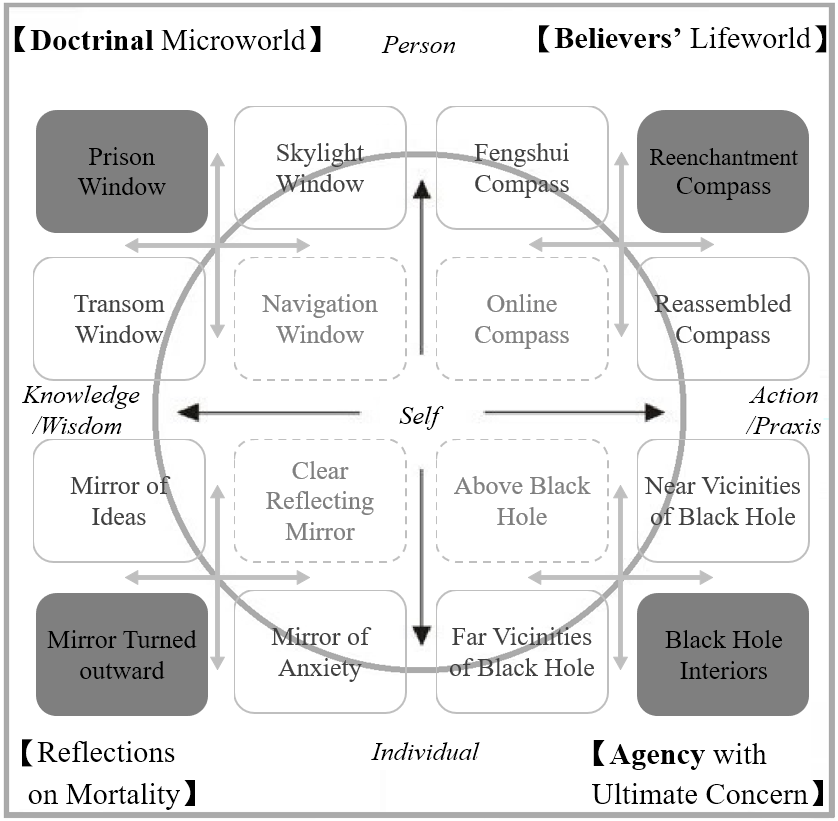
傳統修養學說與經驗中的精華智慧,是漸受重視的濟世良方,也是蘭石一生追求。本專書依「傳統智慧之科學理論化的三步驟知識論策略」,先以「四重四句辯證框架」建構自我修養的存有論模型,再藉此普世性模型,建構一系列不同傳統的文化特殊性模型,並梳理出名為「辯證正念」的正念修習程序;且須大量搜羅、統整古籍與當代學術著作中的案例,藉前述模型對宗教性進行多方剖析。本書大幅增修而整合了蘭石2016到2023年間運用此「知識論策略」與「辯證框架」發表在《本土心理學研究》、《中華輔導與心理學報》與《Frontiers in Psychology》的一系列有序展開諸模型的論文,並擴展到更重要課題。書中闡釋「四重四句」如何彌補主客分立思維盲點,從而建立心靈研究法且開展「自我修養」存有論模型,以充分案例強化此諸多模型的合理性、易懂性與使用方便性。由於期刊論文受限於篇幅與體例,都難以闡述上述知識論策略與辯證框架,且無法鋪陳大量案例。因此,本計畫是蘭石必不可免的任務。因為唯有闡明這一系列研究的知識論策略與辯證框架,才能讓這研究進一步擴展,且呈現其價值:整合人文學來提供社會科學的存有論基礎,作為「傳統智慧之科學理論化」的前兩步;也提供修行者一個旅程地圖。
Traversing the Path of Cultivation:
The Dialectical Mandala Model of Dialectical Mindfulness, Traditional Self-Cultivation, and Religiosity
Azanlansh, Orchid-Stone Chang. 2026. “The Dialectical Mandala Model of Mindfulness: A Novel Model Revealing the Alchemical Logic Underlying Mindfulness Practice” (58 pages; word count: 33,996). Religions 17, no. 7: 824. (July 2026.) (A&HCI 2025 IF=0.6; Scopus Ranking: 78/705=11.06%, Category=RELIGION, Q1). doi: 10.3390/rel17070824 A 33,996-word (58 pages), monograph-style theory-building article that systematically reconstructs the dialectical architecture of mindfulness by integrating Daoist inner alchemy, Buddhist contemplative theory, and catuṣkoṭi dialectics, thereby providing a framework for interdisciplinary dialogue. [8900. 生死太學/修道縱橫]
Azanlansh, Orchid-Stone Chang. (2023). “The Dialectical Mandala Model of Self-cultivation” (17 pages; word count: 11,222). (17 pages; word count: 33,996). Frontiers in Psychology , 13:1024413. (January 2023.) (SSCI 2023 IF=2.900, Ranking=56/219=25.57%, Category=PSYCHOLOGY, MULTIDISCIPLINARY). doi: 10.3389/fpsyg.2022.1024413
張蘭石(2019)。〈宗教的四窗、四鏡、羅盤與黑洞:宗教自我曼陀羅模型的諮商應用〉。《中華輔導與諮商學報》(TSSCI),54(201901),21-58。字数28,859。[Chang, N.-S. (2019). Four windows, four mirrors, compass and black hole of religion: The Mandala Model of Religion and Self applied to counseling. Chinese Journal of Guidance and Counseling, 58, 21-58. DOI: 10.3966/172851862019010054002]
張蘭石(2018)。〈儒家修養曼陀羅模型:華人「天」「鬼神」雙重信仰機制的分析架構〉。字數29539。《本土心理學研究》(台北)(TSSCI),50,3-58。[Chang, N.-S. (2018). The mandala model of Confucian self-cultivation: A framework for analyzing the mechanisms of dual belief in Heaven and spirits within the Chinese funeral tradition. Indigenous Psychological Research in Chinese Societies, 50, 3-48. DOI: 10.6254/IPRCS.201812_(50).0001]
張蘭石(2017):〈源自死亡焦慮的宗教委身機制:分析與模型建構〉。字數21589。《本土心理研究》(台北)(TSSCI),48(201712),頁231-277。[Chang, N.-S. (2017). The mechanisms for religious commitment activated by death anxiety: An Analysis and Model Construction. Indigenous Psychological Research in Chinese Societies, 48, 231-277. DOI: 10.6254/2017.48.231]
張蘭石(2016):〈四句的應用:心靈現象之多面向研究法〉。《本土心理學研究》(台北)(TSSCI),46(201612),25-71。DOI: 10.6254/2016.46.25 [Chang, N.-S. (2016). The Application of the Catuṣkoṭi: The Multi-Aspect Approach to Understanding Psychic Phenomena. Indigenous Psychological Research in Chinese Societies, 46. 25-71. doi: 10.6254/2016.46.25]